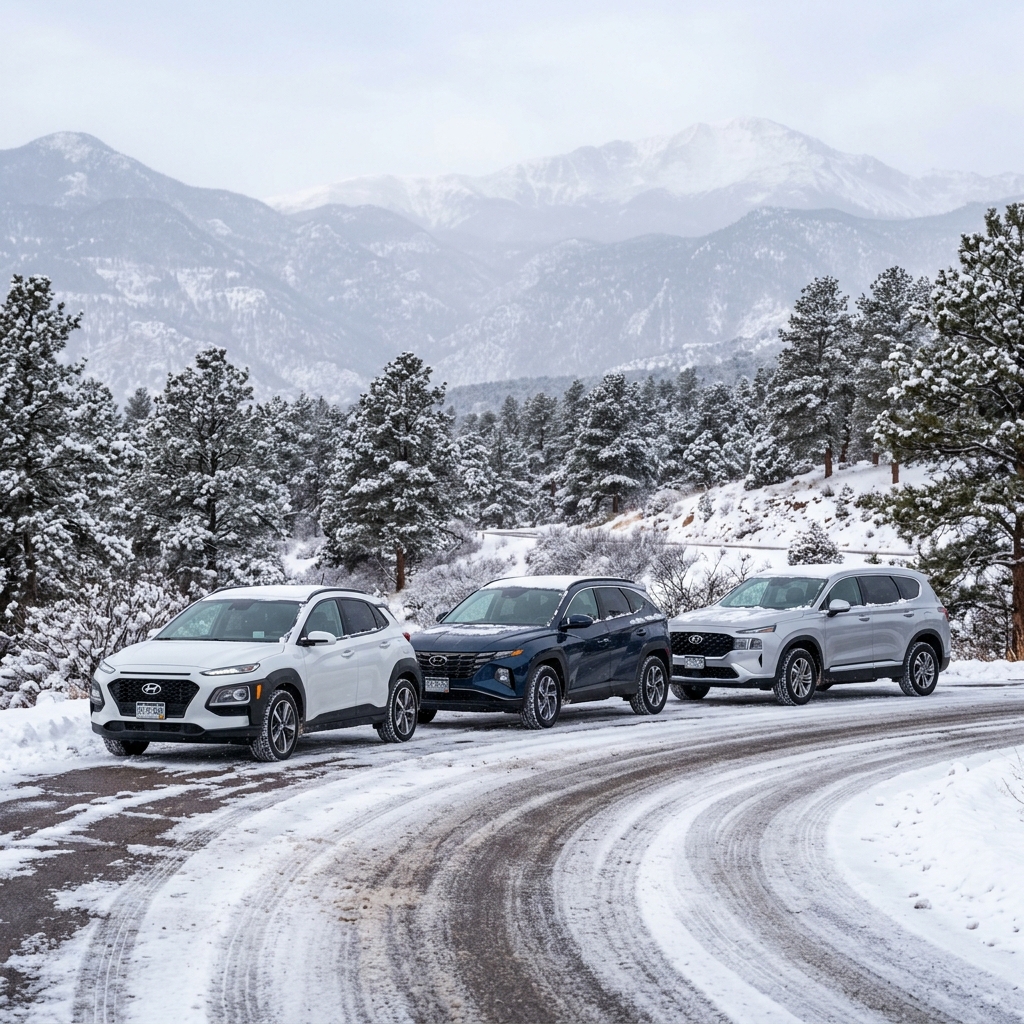
How Hyundai HTRAC All-Wheel Drive Operates in Winter Weather: Direct Answer & Core Mechanics
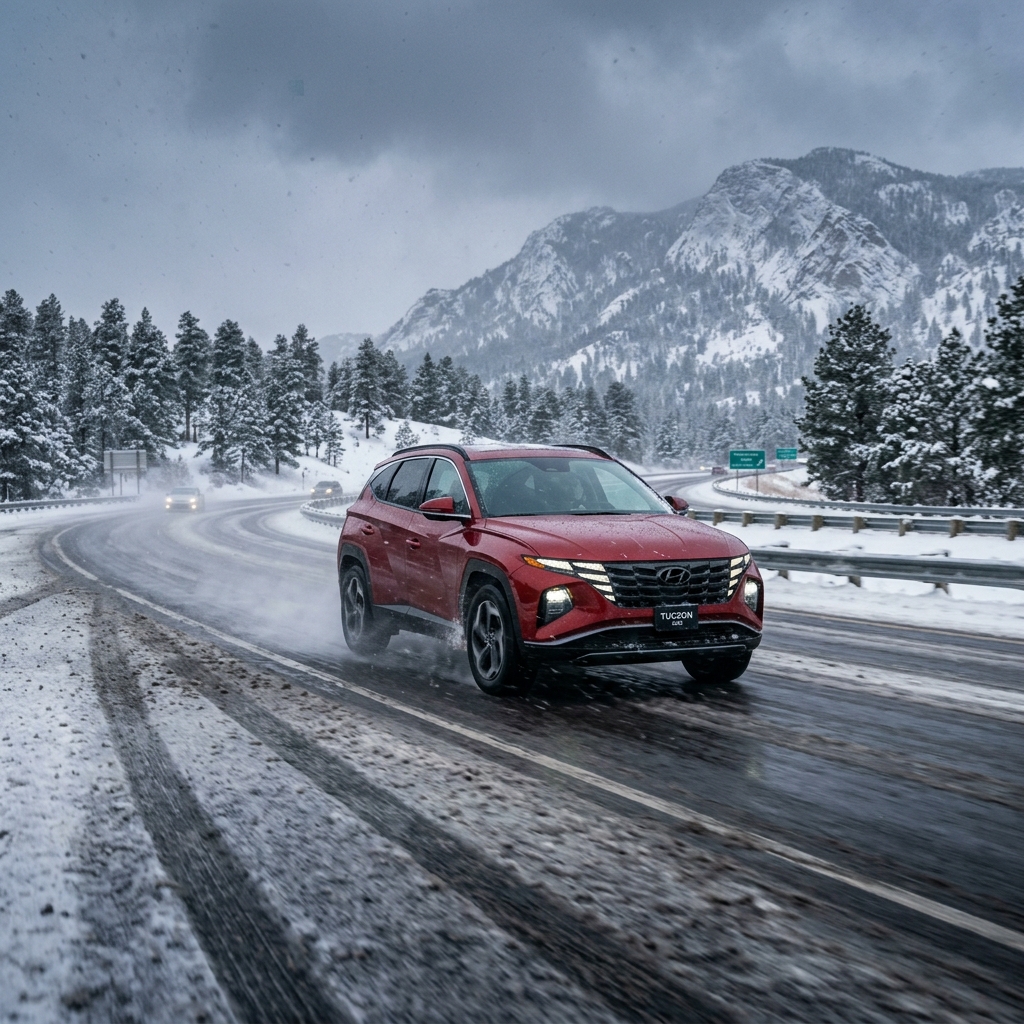
When winter conditions descend upon the Colorado Front Range, drivers face a treacherous mix of black ice, packed snow, freezing slush, and sudden temperature plunges. Navigating these hazards requires a drive system that does far more than simply react after tires begin to spin. Hyundai HTRAC All-Wheel Drive (AWD) is an advanced, multi-mode electro-hydraulic system designed to continuously monitor road conditions and driver inputs, actively distributing engine torque between the front and rear axles to secure traction before wheel slip ever occurs.
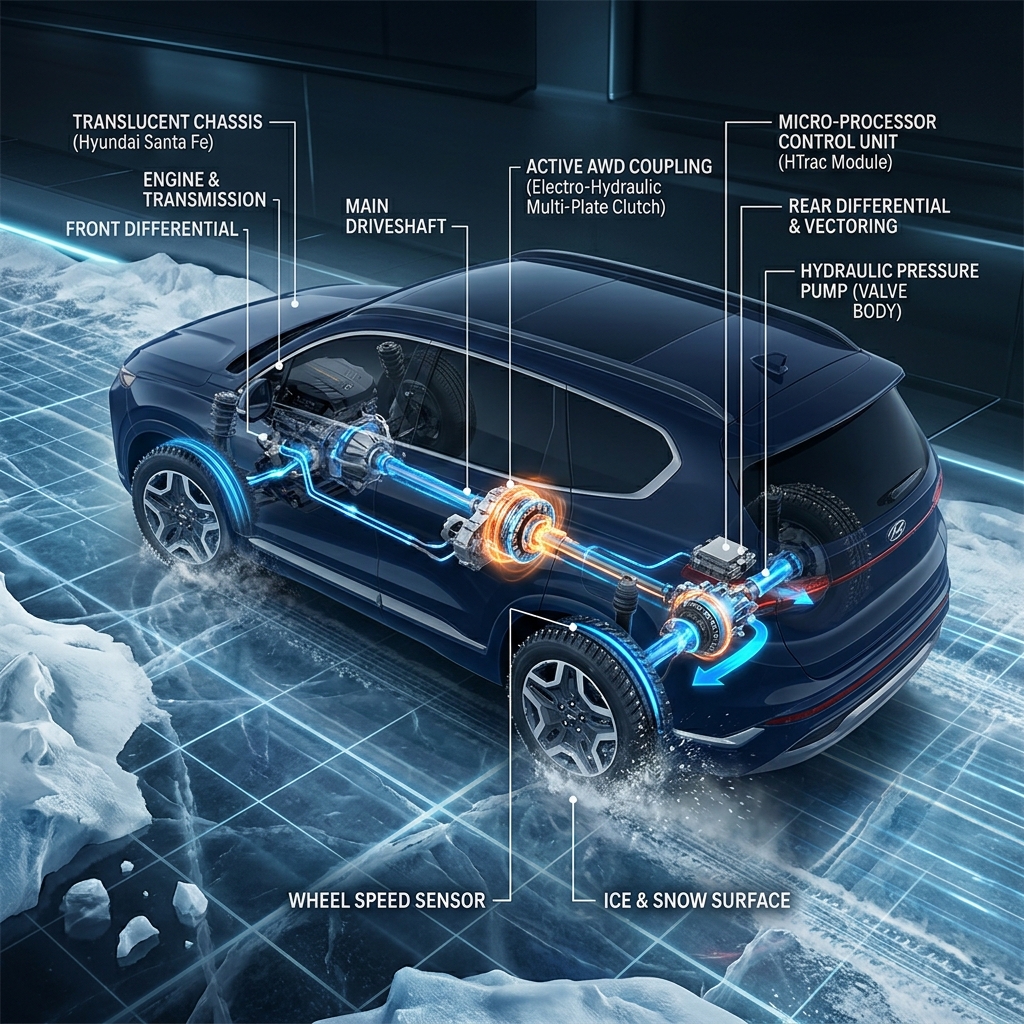
Unlike traditional mechanical four-wheel-drive systems that require manual driver engagement—or older reactive AWD setups that rely on front-wheel spinning to trigger rear axle engagement—HTRAC is inherently proactive. Built with high-speed microprocessors integrated directly into the vehicle's controller area network (CAN bus), HTRAC samples input data up to 100 times per second. It evaluates vehicle speed, individual wheel rotational speeds, steering wheel angle, lateral acceleration, throttle position, and ambient temperature to instantly calculate the ideal torque balance required for absolute stability.
Under normal, dry pavement cruising conditions along I-25, HTRAC routes nearly 100% of engine torque to the front wheels to maximize fuel efficiency. However, the moment you accelerate onto a icy incline near Woodmen Road or hit a patch of slush in black ice territory, the system's electronically controlled multi-plate clutch pack engages within milliseconds. Torque is seamlessly shifted rearward, establishing up to a 50:50 front-to-rear lockup split. This dynamic power modulation ensures that whatever wheel has traction receives the energy needed to keep your vehicle tracking true. If you want to experience this system firsthand, Get Directions to #1 Phil Long Hyundai of Motor City today.
Torque Vectoring and Electronic Control: Preventing Wheel Slip on Frozen Roads
At the core of Hyundai HTRAC's winter superiority is its sophisticated electro-hydraulic clutch coupling mechanism paired with Electronic Torque Vectoring Control. Traditional open differentials send power along the path of least resistance. On ice, that means power dumps into the wheel with zero grip, causing it to spin uselessly while the vehicle sits immobile. HTRAC completely eliminates this vulnerability by pairing longitudinal (front-to-back) power distribution with lateral (left-to-right) torque control.
Through precise braking inputs applied to individual wheels—a process known as Brake-Based Dynamic Torque Vectoring—the HTRAC system simulates a limited-slip differential. If the driver's side front tire hits a patch of slick ice while turning onto Academy Boulevard, the electronic stability control (ESC) gently clamps the brake caliper on that spinning wheel. This resistance instantly redirects torque across the axle to the passenger-side wheel on solid pavement, pulling the vehicle through the turn without loss of momentum or steering control.
Furthermore, yaw rate sensors continuously measure whether the vehicle is turning as intended or beginning to understeer (plowing straight) or oversteer (tail-sliding). In an understeer scenario on a snowy curve, HTRAC routes additional drive torque to the rear axle while dragging the inside rear brake, actively rotating the tail to help the front tires regain turn-in grip. This continuous feedback loop operates invisibly beneath the driver, transforming stressful frozen commutes into confident, controlled rides.
Key HTRAC Execution Metrics:
• Sampling Frequency: 100 Hz (100 calculations per second)
• Torque Transfer Range: 100:0 (Front biased) to 50:50 (Locked split)
• Response Time: Sub-millisecond hydraulic pressure modulation
• Synergistic Systems: ESC, ABS, Motor Driven Power Steering (MDPS), Throttle Position Control
Does the Hyundai Tucson Have a Dedicated Snow Mode for Handling Icy Driving?
Yes! Modern HTRAC-equipped Hyundai SUVs, including the popular Hyundai Tucson, feature a dedicated, driver-selectable Snow Mode accessible via the drive mode selector on the center console. Selecting Snow Mode fundamentally recalibrates how the vehicle's powertrain and chassis control electronics interact with icy, unplowed, or packed snow surfaces.
In standard Drive modes (like Eco or Normal), engine throttle response is sharp, and torque transmission to the front axle is prioritized. In Snow Mode, however, the engine control unit (ECU) deliberately dampens throttle sensitivity. Even if a driver presses the accelerator pedal abruptly on a slick hill, the system smooths out power delivery, preventing aggressive torque spikes that break tire traction and cause immediate wheelspin.
Simultaneously, the transmission recalibrates its shift points, shifting up earlier to keep engine RPMs in a lower, smoother power band and frequently executing starts in second gear to minimize initial breakaway torque. Crucially, Snow Mode alters the HTRAC baseline torque split: instead of starting in front-wheel drive, it engages a permanent baseline rear torque bias (typically 80:20 or 70:30) from a standstill, ensuring all four wheels pull together the moment you step on the gas.
|
Drive Mode
|
Baseline Torque Split (F:R)
|
Throttle Mapping
|
ESC Threshold
|
|
Comfort / Normal
|
100:0 to 80:20
|
Linear / Standard
|
Standard Intervention
|
|
Sport
|
65:35 to 50:50
|
Aggressive / Dynamic
|
Higher Slip Permitted
|
|
Smart
|
Adaptive (Dynamic)
|
Adaptive to Driver Input
|
Standard Intervention
|
|
Snow Mode
|
70:30 to 50:50
|
Dampened / Smooth
|
Traction Optimized
|
By coordinating transmission mapping, throttle curves, and hydraulic clutch engagement, Snow Mode allows drivers to effortlessly pull away from icy neighborhood intersections or climb frozen inclines without erratic slipping or dramatic traction control cuts. To explore our latest models equipped with Snow Mode, browse our New Car Inventory Search.
Is 8.3 Inches of Ground Clearance Sufficient for Mountain Winter Driving in Colorado?
Suburban & City Snowpack Clearing:
With up to 8.3 inches of ground clearance on models like the Hyundai Tucson and Santa Fe, drivers enjoy ample breathing room above unplowed neighborhood streets, thick slush ridges left by snowplows at intersections, and heavy overnight snow accumulations across Colorado Springs.
Preventing High-Centering:
High-centering occurs when deep snow packs under a vehicle's underbody, lifting the tires off solid ground and stranding drive wheels. An 8.3-inch stance provides crucial clearance over packed snow berms, frozen ice chunks, and deep ruts on unpaved foothill access roads without scraping vital componentry.
Underbody & Suspension Protection:
Hyundai SUV underbodies are engineered with protective skid shielding and streamlined fairings. Combined with 8.3 inches of clearance, this design protects the engine oil pan, exhaust piping, and HTRAC transfer assembly from rogue ice blocks on I-25.
Which Compact SUV Has Higher Winter Safety Ratings: Hyundai Tucson or Subaru Forester?
When evaluating compact SUVs for severe winter operation, safety ratings and driver-assistance technology are paramount. Both the Hyundai Tucson and Subaru Forester are perennial favorites in Colorado, but a closer look at crashworthiness testing, crash avoidance technology, and lighting performance reveals why the Hyundai Tucson stands out as a winter safety leader.
The Hyundai Tucson consistently earns top honors, including the prestigious IIHS Top Safety Pick+ award and a 5-Star Overall Safety Rating from the NHTSA. While Subaru's EyeSight system is well-regarded, Hyundai's standard SmartSense Safety Suite offers superior integration with the vehicle's dynamic stability controls during freezing conditions.
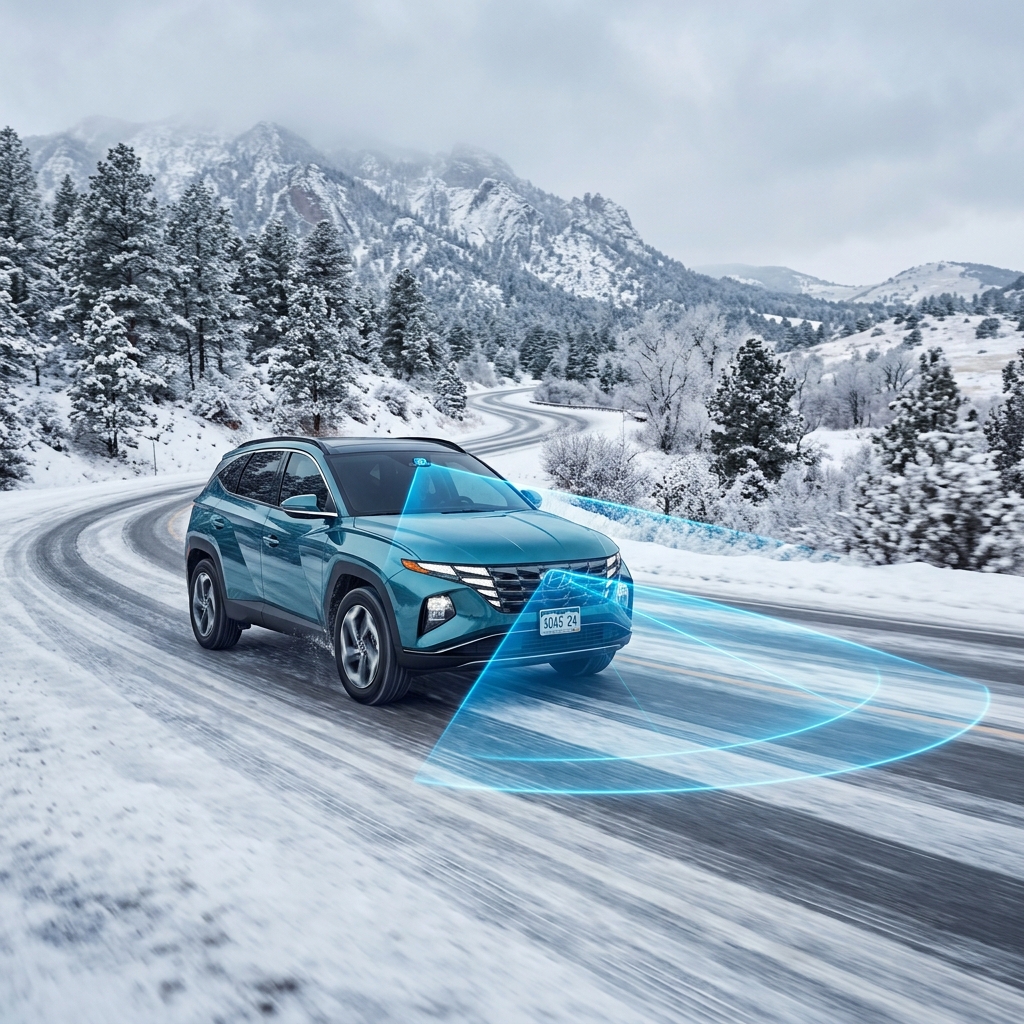
Features like Forward Collision-Avoidance Assist with Pedestrian, Cyclist, and Junction Turning Detection utilize radar and camera fusion that remains operational in cold, foggy conditions. Additionally, Tucson's available heated radar elements prevent front sensor blinding from slush build-up, ensuring lane-keeping and emergency braking functions remain active during winter whiteouts along Monument Hill.
|
Safety & AWD Feature
|
Hyundai Tucson HTRAC
|
Subaru Forester AWD
|
|
IIHS Top Safety Pick+
|
Yes
|
Yes
|
|
NHTSA Overall Rating
|
5 Stars
|
5 Stars
|
|
AWD Engagement Type
|
Predictive Electro-Hydraulic
|
Continuous Active Torque Split
|
|
Standard Headlights
|
LED Projector / High Beam Assist
|
LED Responsive
|
|
#1 Hyundai Motor City EXCLUSIVE Included Powertrain Warranty
|
30-Year / 300,000-Mile
|
5-Year / 60,000-Mile
|
Built-In Cold-Weather Features: Eliminating Aftermarket Remote Starters in Colorado Springs
Bluelink® Remote Climate Pre-Conditioning:
Forget stepping out into sub-zero morning winds to warm up your vehicle. Using the Hyundai Bluelink® smartphone app, you can remotely start your SUV, set the exact cabin temperature, enable the windshield defroster, turn on heated seats, and activate the heated steering wheel from your kitchen counter. No third-party fobs required.
Multi-Stage Heated Seating & Steering Wheel:
Hyundai compact SUVs offer rapid-warming heated front seats with up to 3 intensity levels, alongside available heated rear seats for back passengers. The leather-wrapped heated steering wheel reaches full comfort temperature in under two minutes, rapidly soothing cold hands during frosty commutes.
Heated Side Mirrors & Windshield Wiper De-Icer:
Integrated heating elements inside the side mirrors clear frost and fog rapidly for complete rearward visibility. Furthermore, front windshield wiper de-icers melt ice trapped at the base of the glass, preserving wiper blade rubber and preventing dangerous snow streaking across your field of view.
Is the Hyundai Tucson Good for Driving in Deep Snow and Icy Winter Conditions?
When winter storms hit the Front Range, dumping multiple inches of wet, heavy snow overnight, driver confidence relies on every mechanical component working in total harmony. The Hyundai Tucson excels in these extreme conditions thanks to the tight integration between the HTRAC all-wheel-drive system, braking sub-systems, and engine powertrain management.
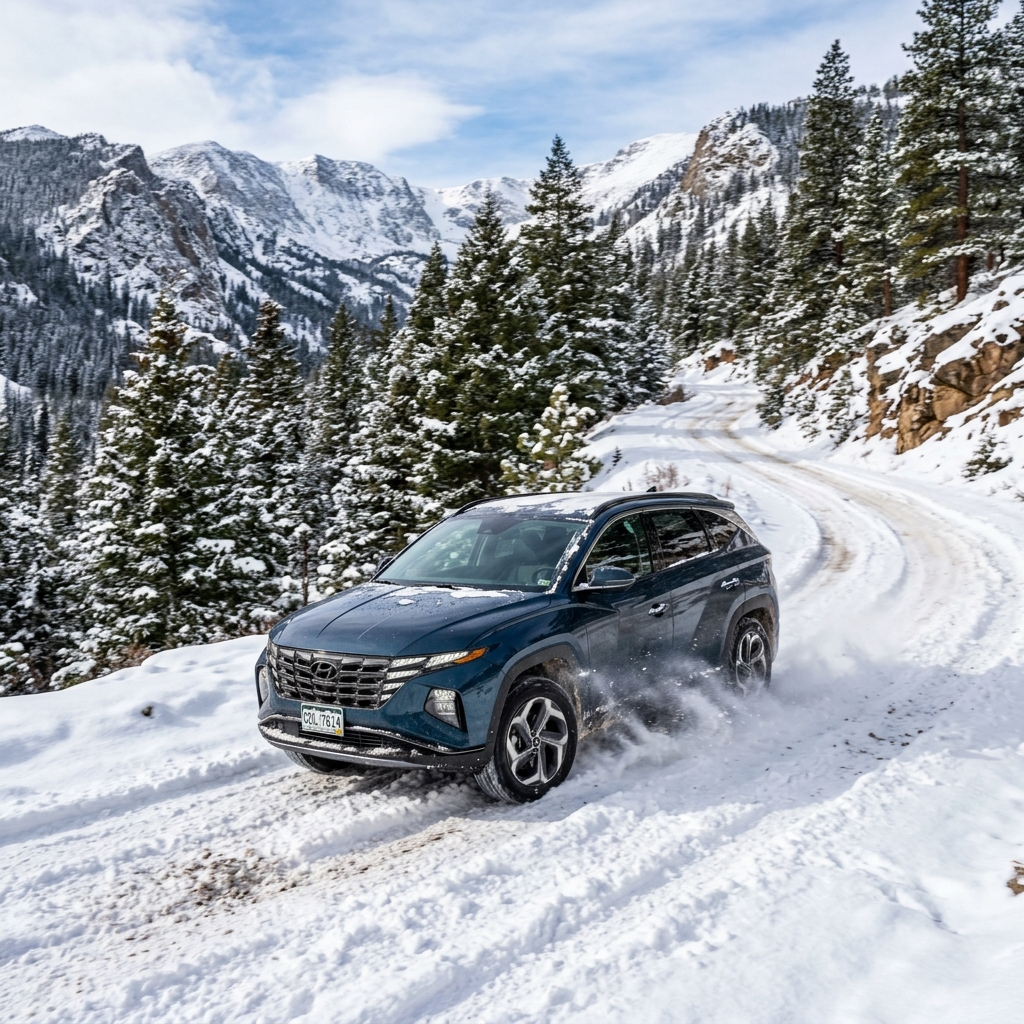
In deep snow conditions where maximum traction is required to break through heavy drifts, drivers can manually engage the AWD Lock Button (or select Snow/Mud Mode depending on trim). This forces an immediate 50:50 torque split between the front and rear axles at speeds up to 25 mph. Combined with Downhill Brake Control (DBC) and Hill-Start Assist Control (HAC), descending or ascending steep snow-covered grades becomes controlled and predictable.
Unlike lightweight cross-over systems that overheat their coupling units after prolonged snow spinning, HTRAC's heavy-duty electro-hydraulic system maintains thermal stability during extended snow plowing. Whether you're navigating unplowed neighborhood streets in Cimarron Hills or making an early morning drive up to the ski resorts, the Tucson delivers unyielding winter composure. If you have pre-owned vehicles in mind, check out our Search Pre-Owned Inventory selection.
How Much Extra Does HTRAC AWD Cost on Hyundai Compact SUVs?
Adding HTRAC All-Wheel Drive to a Hyundai compact SUV is one of the most cost-effective upgrades a Colorado driver can make. On models like the Hyundai Tucson and Kona, HTRAC AWD is typically an accessible option added to the front-wheel-drive base MSRP—typically adding around $1,500 to $1,700 depending on trim level (and comes standard on select rugged trims like the X-RT).
Long-Term Value Retention & Resale Value:
In Colorado's car market, all-wheel drive is not merely a comfort feature—it is a mandatory requirement for a large percentage of buyers. Equipping your Hyundai with HTRAC AWD preserves significantly higher resale and trade-in values compared to FWD variants. When it comes time to trade in your vehicle, HTRAC frequently recoups nearly its entire upfront cost. You can Value Your Trade OR Sell Us Your Car today to see what your current vehicle is worth.
Fuel Economy Trade-Offs:
Thanks to HTRAC's intelligent automatic rear-axle disconnect feature during dry highway cruising, the fuel economy penalty for AWD is minimal—typically only 1 to 2 MPG lower on highway ratings compared to front-wheel-drive models. Ready to secure competitive financing terms? Apply For Financing online in minutes.
|
Hyundai SUV Model
|
Standard Drive
|
HTRAC AWD Option Cost
|
Fuel Efficiency Delta
|
|
Hyundai Kona
|
FWD Standard
|
~$1,500 MSRP
|
-1 to -2 Combined MPG
|
|
Hyundai Tucson
|
FWD Standard
|
~$1,500 MSRP
|
-1 Combined MPG
|
|
Tucson X-RT
|
HTRAC Standard
|
Included Standard
|
N/A (AWD Standard)
|
|
Hyundai Santa Fe
|
FWD Standard
|
~$1,800 MSRP
|
-1 to -2 Combined MPG
|
Evaluating the Best Compact Hyundai SUVs for Colorado Springs Winters
Hyundai Kona HTRAC:
Ideal for urban commuters navigating downtown Colorado Springs or suburban neighborhood streets. Compact footprint makes parallel parking in icy conditions effortless, while available HTRAC AWD and short overhangs handle urban slush piles with ease.
Hyundai Tucson HTRAC:
The ultimate balance of interior volume, passenger comfort, and winter capability. Offers 8.3 inches of ground clearance, expanded cargo room for ski gear, and advanced Snow Mode dynamics suitable for both daily commutes and weekend mountain passes.
Hyundai Santa Fe & Palisade:
For larger families requiring 3-row seating or enhanced towing capacity for snowmobiles and trailers, Santa Fe and Palisade with HTRAC deliver rugged power, elevated towing stability modes, and premium winter cabin luxury.
Navigating Winter Commutes Across Security-Widefield, Cimarron Hills, and Pikes Peak Routes
Driving in El Paso County during winter requires navigating severe microclimates and rapid elevation changes. A clear, sunny morning in Security-Widefield can quickly give way to blinding squalls and black ice as you drive north along the Powers Boulevard corridor toward Cimarron Hills or climb west toward Ute Pass along Highway 24.
As elevation increases from around 6,000 feet in southern Colorado Springs up to over 7,500 feet in Palmer Lake, road temperatures drop dramatically. Shaded stretches along Highway 24 beneath Pikes Peak frequently harbor hidden patches of black ice long after main thoroughfares have dried out.
This regional terrain unpredictability is precisely why HTRAC AWD is indispensable for local drivers. As you transition from dry asphalt to an icy bridge deck over Fountain Creek, HTRAC instantly senses the micro-slippage of individual wheels and transfers torque within milliseconds, keeping your trajectory stable.
Whether you are taking a daily commute to Fort Carson, heading out along Highway 94 toward Schriever Space Force Base, or taking a weekend trip into the Rocky Mountains, HTRAC provides continuous peace of mind across every corridor in Southern Colorado.
Pairing HTRAC All-Wheel Drive with Winter Tires for Extreme Front Range Storms
While Hyundai HTRAC AWD is a masterclass in dynamic mechanical power allocation, all-wheel drive only manages the power delivered to the tire contact patch. The absolute level of grip available depends entirely on rubber compound friction. Standard all-season tire rubber hardens when ambient temperatures drop below 45°F, drastically reducing elasticity and road adhesion.
Pairing HTRAC AWD with dedicated winter or snow tires (bearing the 3-Peak Mountain Snowflake 3PMSF rating) unlocks unmatched winter capability. Dedicated winter tires utilize specialized hydrophilic rubber compounds that remain soft and pliable in sub-freezing temperatures, combined with thousands of high-density sipes that bite directly into packed snow and ice.
The Stopping Distance Advantage:
It is vital to remember that all-wheel drive assists with acceleration and directional stability, but does not decrease braking distances on ice. Winter tires paired with HTRAC can reduce emergency stopping distances on frozen pavement by up to 30 feet—frequently the exact distance between a safe stop and a fender bender during sudden I-25 traffic slowdowns.
At Phil Long Hyundai of Motor City, our tire center carries a comprehensive lineup of factory-recommended winter tire packages tailored specifically to your Hyundai Tucson, Kona, or Santa Fe wheel specifications.
Preparing Your Hyundai for Winter: Maintenance Services at Phil Long Hyundai of Motor City
Battery Cold-Cranking Test:
Freezing temperatures can reduce battery capacity by up to 50%. Our factory-trained technicians conduct load tests and check cold-cranking amps (CCA) to ensure reliable engine start-up during freezing cold snaps.
HTRAC Fluid & Transfer Case Inspection:
To maintain optimal hydraulic clutch operation, our service team checks rear differential gear oil and electro-hydraulic coupling fluid levels, verifying protection against internal wear during heavy load conditions.
Coolant Flush & Brake Check:
We test coolant/antifreeze concentration levels to prevent engine block freezing, inspect brake pads and rotors for salt corrosion, and top off low-temperature washer fluid. Learn more at our Service Center Information hub.
Test Drive HTRAC All-Wheel Drive Models at Phil Long Hyundai of Motor City
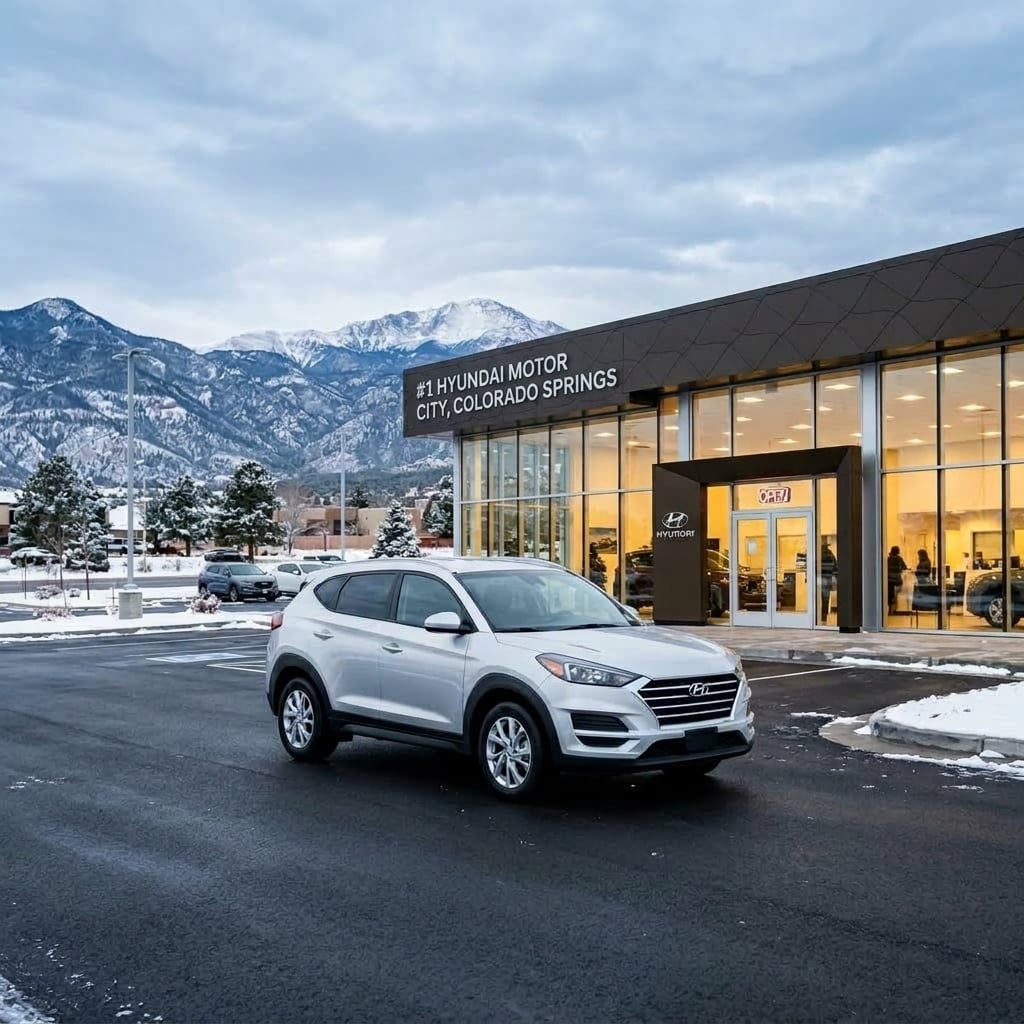
There is no substitute for experiencing the confidence of Hyundai HTRAC All-Wheel Drive in person. At #1 Phil Long Hyundai of Motor City, we are proud to offer Southern Colorado's largest selection of new and certified pre-owned Hyundai SUVs. Whether you are seeking the agile Kona, the versatile Tucson, or the spacious Santa Fe or Palisade, our knowledgeable sales consultants are ready to help you find the perfect winter-ready vehicle.
Every new vehicle purchase is backed by the #1 Hyundai Motor City Warranty Promise, giving original owners powertrain limited warranty protection INCLUDED for up to 30 years or 300,000 miles (good at any ASE Certified Service Center nationwide). We also specialize in helping customers with all credit backgrounds with zero cash down and offers no payments for 90 days (WAC).